
Stop guessing where your operations are leaking time.
Pick one workflow that feels heavier than it should. In 1–2 weeks, you get a decision document: mapped, measured in hours and francs, and ranked by what to fix first.
The expensive part is not the diagnostic. It is another quarter of the same workflow leaking time unnoticed.
01 — Symptom matrix
If this feels normal, it is already costing you.
Most founder-led SMEs do not notice workflow friction because it looks like normal coordination. If two or more of these apply, one workflow is probably worth diagnosing before buying another tool.
- 01I still approve too many routine decisions
- 02The team asks me for context they should already have
- 03Client information gets copied between email, CRM, and spreadsheets
- 04Status updates require chasing
- 05We've discussed automation, but nobody knows where to start
02 — Diagnostic rationale
The problem is rarely the tool first.
Workflow friction usually comes from a small number of structural causes. Naming them precisely is what allows the right move — whether that is a process change, a delegation rule, or, only then, automation.
Diagnose first. Automate only where it earns its place.
01
Ownership
02
Duplication
03
Handoffs
04
Dependency
05
Premature automation
What a single noisy workflow can quietly cost.
Adjust the inputs to reflect one of your workflows. The output is an order of magnitude — useful for prioritisation, not a promise.
- Manual touchpoints / item6
- Minutes per touchpoint8 min
- Items per week40
- Loaded hourly costCHF 85
That's an estimate from three inputs. The real number is usually worse, and it's hidden in the handoffs. Want it verified against your actual workflow?
Email me this estimate04 — What typically improves after a Workflow Diagnostic
From guesswork to a defined process.
Illustrative improvement areas based on typical SME workflow patterns — not a client testimonial.
Unclear ownership
Clear workflow roles
Decisions don't stall waiting for someone to claim them.
Manual chasing
Defined triggers and handoffs
Work moves on its own — nobody has to ask for status.
Founder dependency
Decision rules
Routine calls get made without the founder in the loop.
Scattered tools
Cleaner information flow
One source of truth, instead of five places to check.
Automation guesses
Prioritised automation candidates
Automation gets built where it actually pays off.
This is the decision document you get.
A short, structured report. Built to be read by the founder in one sitting and used to make decisions in the following week.
- Workflow map. Stages, roles, systems, decisions
- Bottleneck analysis. Where time and clarity are lost
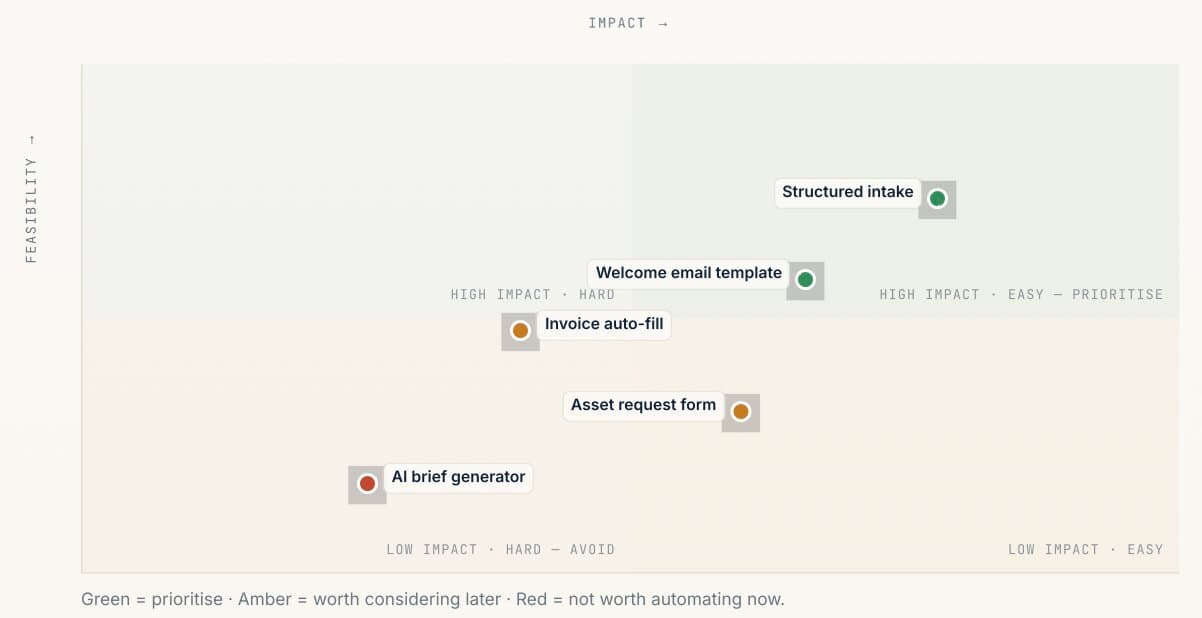
- Priority matrix. Impact × effort, plotted
- 30-day roadmap. Sequenced, owner-assigned
- Automation readiness notes. What is safe to automate, and what is not
06 — Is this for you?
Fit and not fit
- You run a service business or small operational team
- A specific workflow is clearly heavier than it should be
- The founder is involved in decisions that shouldn't require them
- Handoffs between people or tools are unclear or inconsistent
- Automation has been discussed but the right starting point is unclear
- You want to understand the problem before investing in solutions
- You need someone to build software or deploy automation directly
- You want a general IT or digital transformation project
- You need immediate implementation, not a diagnostic
- You already have a clear diagnosis and just need execution support
- The business has fewer than 5 people and only one simple workflow

07 — About
Vladyslav Shmelkov — based in Switzerland. Independent workflow diagnostic work, with no software commissions.
Background in Business Engineering (MSc, OST — Eastern Switzerland University of Applied Sciences), with a focus on mathematical optimization and simulation. That's the same lens applied here: model how the work actually flows, quantify where it breaks, and rank what to fix first.
- Independent practice
- Based in Switzerland
- No software commissions
- MSc Business Engineering
08 — Get started
Send a diagnostic request.
Tell me which workflow feels heavier than it should. I'll review the context and reply with the most relevant next step.
This goes straight to me — no sales team, no automatic proposal.